Infosec Brigade

Identify Web Vulnerabilities Simulate Attacks Secure Your Applications

Protect your web applications from real-world attacks with comprehensive penetration testing. We simulate attacker behavior to identify exploitable vulnerabilities, validate security controls, and provide actionable remediation guidance to strengthen your application's overall security posture.
API Penetration Testing | Elite Security Services
ISO 27001:2022 Certified
OWASP API Security Top 10
OSCP & OSWE-Certified Team
24/7 Incident Response
VAPT Certificate Issued

What is API Penetration Testing?

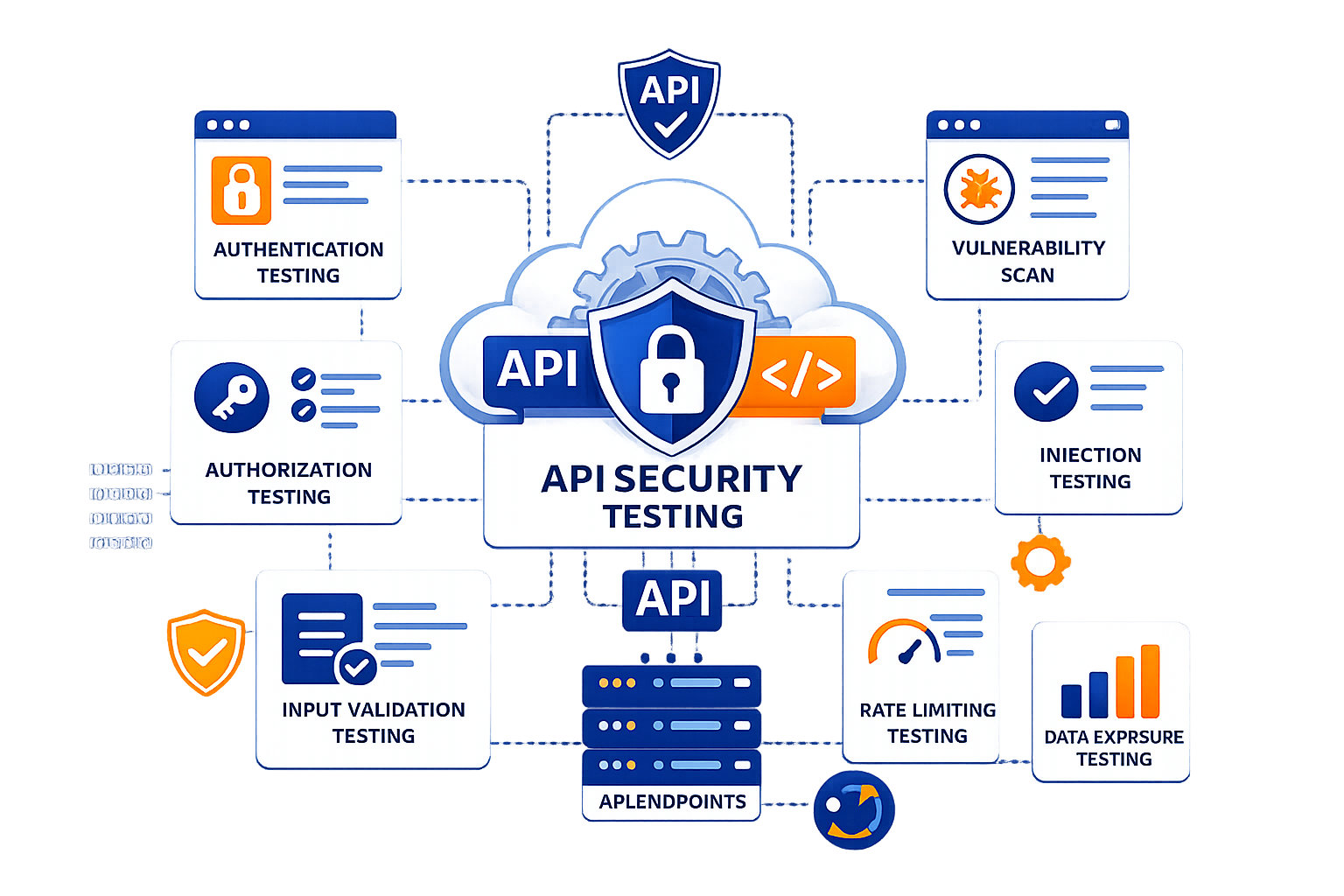
API Penetration Testing is a comprehensive, hands-on security assessment that simulates real-world attacks against your application programming interfaces — REST, GraphQL, SOAP, gRPC, and WebSocket APIs — to discover and remediate vulnerabilities before adversaries exploit them.

Our certified engineers manually test every endpoint, authentication mechanism, authorisation control, and business logic flow. We go beyond automated scanners to uncover BOLA/IDOR chains, JWT forgery, mass assignment, rate-limiting bypasses, and complex multi-step business logic flaws that tools consistently miss.

  • 🔗
    Full API Attack Surface Coverage Every endpoint, method, parameter, and header tested — including undocumented shadow APIs and deprecated versions still exposed in production.
  • 🏅
    Regulatory Compliance Meet PCI-DSS, ISO 27001, SOC 2, HIPAA, and GDPR requirements with documented evidence of API security validation aligned to OWASP API Top 10.
  • 🛡️
    Business Logic & BOLA Testing Identify broken object-level authorisation, privilege escalation chains, and data exposure paths that automated scanners fundamentally cannot detect.
  • Zero Operational Disruption All testing conducted against staging or production environments using safe, controlled payloads — no data corruption, no denial of service.
Common API Vulnerability Distribution
Broken Object-Level Authorisation (BOLA)91%
Broken Authentication & JWT Flaws78%
Excessive Data Exposure72%
Broken Function-Level Authorisation64%
Mass Assignment & Parameter Tampering55%
Missing Rate Limiting & Injection48%

API Pentest Methodology

A structured 6-phase engagement aligned to OWASP API Security Top 10, NIST SP 800-95, and REST/GraphQL security best practices — delivering full endpoint coverage.

01
📋
Scoping & Documentation Review
Review OpenAPI specs, Postman collections, WSDL, and architecture diagrams to map the complete API attack surface before testing begins.
02
🔍
Endpoint Discovery & Recon
Enumerate all documented and undocumented endpoints, discover shadow APIs, deprecated versions, and hidden admin routes via crawling and fuzzing.
03
🔐
Authentication & Authorisation Testing
Test JWT/OAuth2/API key implementations for forgery, algorithm confusion, token leakage, session fixation, and BOLA/BFLA privilege escalation paths.
04
⚔️
Business Logic & Injection
Manually probe business workflows for logic flaws, mass assignment, excessive data exposure, SQLi, NoSQLi, XXE, SSRF, and command injection payloads.
05
📈
Rate Limiting & DoS Testing
Validate throttling controls, resource exhaustion vectors, GraphQL batching abuse, and large payload handling to assess denial-of-service resilience.
06
📄
Reporting & Remediation
Deliver detailed technical report with CVSS-scored findings, request/response evidence, attack chains, and developer-ready code-level remediation guidance.

Tailored for Every API Architecture

Whether you run REST microservices, a public GraphQL gateway, or legacy SOAP integrations — our assessments are scoped precisely to your architecture and threat model.

🔗
Protocol

REST & HTTP API Testing

Comprehensive assessment of RESTful APIs covering all HTTP methods, parameter types, authentication schemes, and header-based controls. We test for BOLA, mass assignment, injection, excessive data exposure, and rate-limiting weaknesses across every endpoint.

OWASP API Top 10 BOLA / IDOR JWT & OAuth2 Parameter Fuzzing
Protocol

GraphQL Security Testing

Specialised GraphQL assessment targeting introspection exposure, query depth abuse, batch attack vectors, field-level authorisation bypasses, and injection through nested resolvers. We evaluate both queries and mutations for data exposure and privilege escalation.

Introspection Abuse Batch Query DoS Field-Level AuthZ Resolver Injection
📡
Protocol

SOAP & gRPC Testing

Legacy SOAP and modern gRPC assessments covering WSDL enumeration, XML injection, XXE, and WS-Security weaknesses for SOAP — and protobuf tampering, reflection API abuse, and authorisation gaps for gRPC services.

XXE & XML Injection WSDL Enumeration gRPC Reflection WS-Security

Black Box, Grey Box & White Box API Testing

Select the engagement model that best matches your API's threat exposure, compliance requirements, and development maturity — or let our experts recommend the optimal approach.

Black Box
Black Box Pentest
Zero-Knowledge External API Attack Simulation
  • Most realistic unauthenticated attacker perspective
  • No documentation, credentials, or prior access provided
  • Discovers exposed endpoints & unauthenticated data leaks
  • Ideal for public APIs and pre-launch validation
Grey Box
🔲
Grey Box Pentest
Authenticated User / Developer Access Model
  • Simulates a compromised user or API token holder
  • Tests BOLA, privilege escalation & business logic deeply
  • Optimal coverage-to-cost ratio — our recommendation
  • Includes OpenAPI spec review and authenticated fuzzing
White Box
White Box Pentest
Full Source Code & Architecture Review
  • Full API source code, specs, and architecture provided
  • Combines static code analysis with live exploitation
  • Maximum vulnerability coverage — zero blind spots
  • Ideal for regulated environments and API-first platforms

Not sure which approach is right for your API stack?

Get a Free Consultation →

OWASP API Security Top 10 — Full Coverage Guaranteed

Every engagement is benchmarked against the OWASP API Security Top 10, NIST SP 800-95, and REST/GraphQL security best practices. We test every class of API vulnerability.

🔓
API1
Broken Object Level Authorization
🔑
API2
Broken Authentication
🏷️
API3
Broken Object Property Level Authorization
📦
API4
Unrestricted Resource Consumption
🔧
API5
Broken Function Level Authorization
🔄
API6
Unrestricted Access to Sensitive Flows
💉
API7
Server Side Request Forgery (SSRF)
⚙️
API8
Security Misconfiguration
📚
API9
Improper Inventory Management
🤖
API10
Unsafe Consumption of APIs
🪙
Auth
JWT & OAuth2 / OpenID Flaws
🧠
Logic
Business Logic & Workflow Abuse

The Highest Standard of API Pentesting

We go far beyond running automated API scanners. Our engineers apply real adversarial thinking to find the complex, chained vulnerabilities that tools consistently miss — and that matter most to your business.

🏅

CCV-Pentesting Trustseal

Fully compliant with CCV's rigorous penetration testing standards — one of the most demanding quality marks in the industry. Every API engagement is fully auditable and reproducible.

📄

Developer-Ready Reporting

Every finding includes full HTTP request/response evidence, step-by-step reproduction, CVSS v3.1 scoring, business impact analysis, and code-level remediation guidance your dev team can act on immediately.

👨‍💻

OSCP & OSWE-Certified Specialists

Every engineer holds current OSCP and OSWE (Offensive Security Web Expert) certifications — the gold standard for hands-on API and web security expertise. No juniors, no automated-only assessments.

🔄

Free Retest & VAPT Certificate

We verify every remediation at no additional cost. Upon successful closure, we issue a VAPT Certificate — a trusted credential for clients, auditors, enterprise customers, and regulators.

Certifications & Standards
🛡️ ISO 27001:2022
ISO 9001:2015
🏆 CCV Pentest Certified
🔐 OSWE Certified Team
📋 OWASP API Top 10
🌐 NIST SP 800-95

Frequently Asked Questions

Everything you need to know about our API Penetration Testing service covering REST, GraphQL, SOAP, and gRPC.

What is an API Penetration Test? +
An API Penetration Test is a targeted security assessment where certified engineers simulate real-world attacks against your application programming interfaces. Unlike automated API scanners, our testers manually probe authentication, authorisation, business logic, and injection vulnerabilities — uncovering complex attack chains such as chained BOLA escalation, JWT algorithm confusion, and GraphQL introspection abuse that tools fundamentally cannot detect.
Do you need access to our source code or API documentation? +
It depends on the engagement model. Black Box testing requires no documentation — we discover and attack your API as an external adversary would. Grey Box testing benefits from an OpenAPI/Swagger spec or Postman collection and test credentials. White Box engagements use full source code and architecture docs for maximum coverage. We always recommend Grey or White Box for the best findings-to-effort ratio.
What is BOLA and why is it so critical? +
Broken Object Level Authorisation (BOLA), also known as IDOR, is the #1 vulnerability in the OWASP API Security Top 10. It occurs when an API endpoint doesn't validate that the requesting user has permission to access the specific object they're requesting — for example, when user A can access user B's orders simply by changing an ID in the URL. BOLA is responsible for the majority of high-impact API data breaches and is almost impossible for automated scanners to detect, making manual testing essential.
Can you test APIs in production environments? +
Yes. Our methodology uses safe, non-destructive payloads carefully crafted to avoid data corruption, unintended deletions, or denial of service. We coordinate all testing windows with your team and use dedicated test accounts or sandboxed data wherever possible. For highly sensitive production environments, we can also operate against a staging or pre-production replica that mirrors your production configuration.
What deliverables will we receive? +
You receive: a detailed technical report with all findings, CVSS v3.1 severity ratings, full HTTP request/response evidence, step-by-step reproduction instructions, and developer-ready code-level remediation guidance; an executive summary for board and C-suite review; attack chain diagrams showing multi-step exploitation paths; a prioritised remediation roadmap; a free retest to verify all remediations; and a VAPT Certificate upon successful closure.
How often should we conduct an API Pentest? +
We recommend annual API penetration testing as a baseline, with additional assessments triggered by major API changes — new versions, new authentication mechanisms, significant new endpoints, or third-party API integrations. Organisations with continuous delivery pipelines often adopt a hybrid model: a full annual pentest combined with lightweight targeted assessments after each major release. PCI-DSS, SOC 2, and ISO 27001 requirements typically mandate at least annual assessments.
GET STARTED

Fast-track your API Security Testing

Start testing in 24 hours. Connect directly with our security experts. And centralize your testing with InfoSec Brigade

Connect With Us